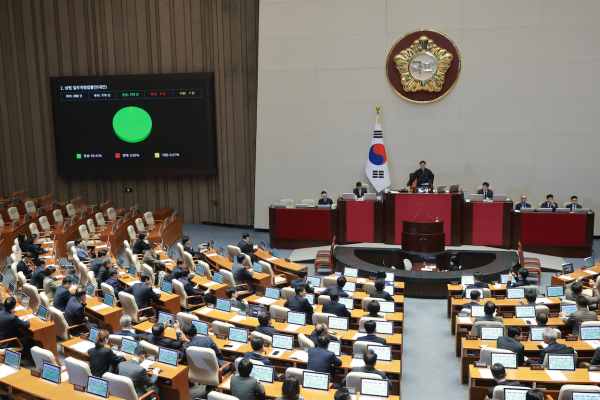
Korea's National Assembly held two significant plenary sessions this month. On 12 February, 63 bills were passed — without opposition participation — followed by a second session on 24 February, where the ruling party pushed through remaining legislative priorities despite an opposition filibuster.
This edition breaks down three key pieces of passed legislation and what they mean for industry:
The mandatory cancellation of treasury shares (Amendment to the Commercial Act) ends the long-standing practice of using corporate funds to entrench controlling shareholders. Companies must cancel newly acquired treasury shares within one year, with a 1.5-year window for existing holdings. Effective immediately upon promulgation in March, the law will already apply to this AGM season — a significant moment in Korea's ongoing effort to close the "Korea discount."
The strengthened data protection enforcement regime (Amendment to PIPA) formalizes CEO-level accountability for data governance, raises administrative fines to up to 10% of total revenue for serious violations, and introduces mandatory certification for large-scale data controllers from July 2027. For any company processing personal data in Korea, this is a material shift in compliance exposure.
The SMR Special Act establishes Korea's first dedicated legal framework for the R&D, demonstration, and commercialization of Small Modular Reactors. Backed by a 1.2 trillion KRW (~USD 830M) government commitment, the Act creates a new cross-ministry promotion body, designates R&D special zones, and enables public-private consortia — positioning Korea to compete globally in next-generation nuclear energy as demand from AI and data centres accelerates.
Find the full analysis of these bills in our newsletter below.